GCSEs for Dads – Physics 2: Electricity
Don’t worry about reading the formulas now. Just know they’re here at the top if you need them. Scroll down to start.
You don’t need to memorise these formulas. Just know where to find them.
Electricity Formulas
| Quantity | Formula | Meaning |
|---|---|---|
| Charge | Q = I × t | charge transferred = current × time |
| Voltage | V = I × R | voltage = current × resistance |
| Power | P = V × I | electrical power = voltage × current |
| Energy transferred | E = P × t | energy = power × time |
Symbols and Units
| Symbol | Meaning | Unit |
|---|---|---|
| Q | Charge | Coulombs (C) |
| I | Current | Amps (A) |
| V | Voltage | Volts (V) |
| R | Resistance | Ohms (Ω) |
| P | Power | Watts (W) |
| E | Energy | Joules (J) |
| t | Time | Seconds (s) |
Physics 2: Electricity
1. What is Electricity?
Electricity is the flow of electric charge through a complete circuit.
A complete circuit is needed for electricity to flow.
Key parts of a circuit:
- Power source (cell or battery)
- Wires
- Components (lamp, resistor, motor etc.)
2. Electric Charge and Current
Inside metal wires are tiny particles called electrons.
When a battery is connected, it pushes electrons around the circuit.
3. Current
Electric charge flows through a circuit.
Current is the rate of flow of charge.
Unit: Amps (A)
- A coulomb is a unit used to measure charge
- 1 amp means 1 coulomb flows each second
- A coulomb is a large bundle of electrons
Big current means lots of charge moving
Small current means little charge moving
Charge equation:
- Q = I × t
Example:
- If 2 A flows for 5 seconds:
- Q = 2 × 5 = 10 C
4. Voltage (Potential Difference)
Voltage is the energy transferred to each unit of charge.
Think of it like pressure pushing electricity through the circuit.
- Unit: Volts (V)
- Higher voltage means a stronger push
5. Resistance
Resistance is how much a component opposes the current.
Think of it like narrowing a pipe. - Unit: Ohms (Ω)
Example:
- Thin wire means high resistance
- Thick wire means low resistance
6. How they all fit together
Relationship between voltage, current and resistance:
V = I × R
This is Ohm’s Law.
- Voltage is the push
- Current is the flow
- Resistance is the restriction
So:
Push = Flow × Restriction
- Voltage does not flow
- Current flows
- Resistance controls the flow
7. Circuits
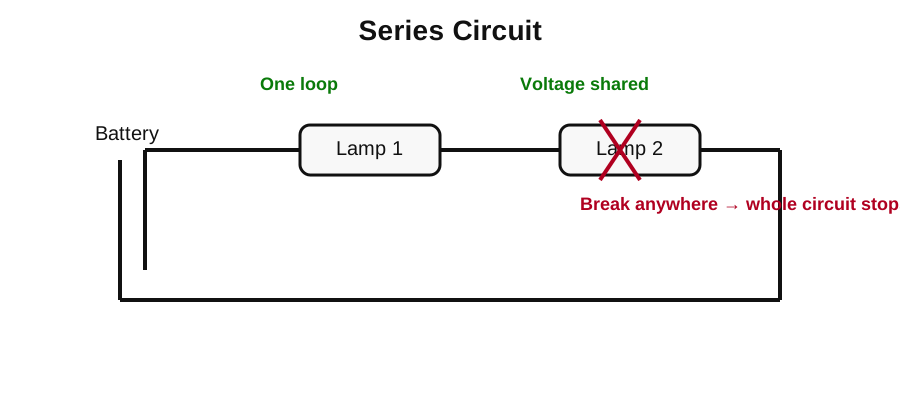
7.1 Series Circuits
A series circuit has one loop.
Rules:
- Current is the same everywhere
- Voltage is shared between components
- Total resistance = sum of resistances
Example:
- R₁ = 3Ω
- R₂ = 2Ω
- Total resistance = 5Ω
If one component breaks, the whole circuit stops.
7.2 Parallel Circuits
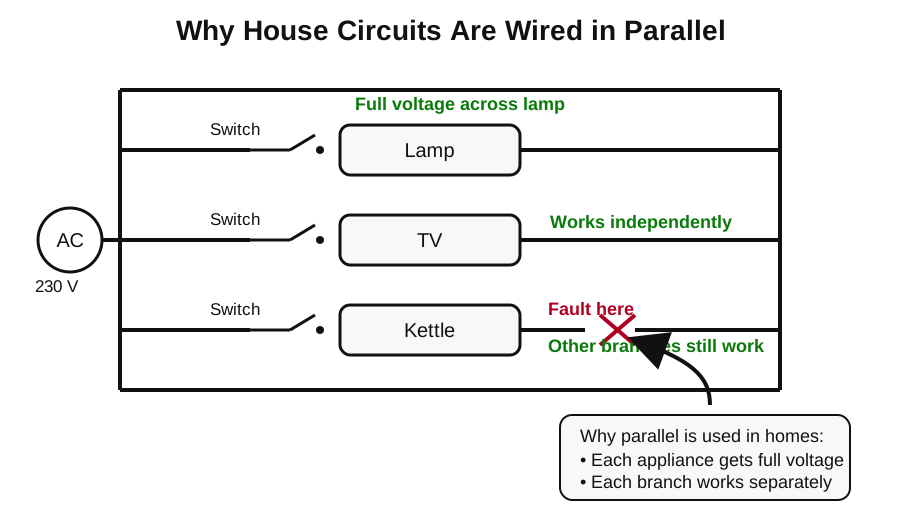
A parallel circuit has multiple paths.
Rules:
- Voltage is the same across each branch
- Current splits across branches
- Resistance decreases when more branches are added
Example:
- If one lamp breaks, the others still work because each branch is its own circuit
- This is why homes use parallel circuits
8. Electrical Power
Power is the rate energy is transferred.
- Unit: Watts (W)
Equation:
- P = V × I
Example:
- 230 V appliance drawing 2 A
- P = 230 × 2 = 460 W
9. Mains Electricity (UK)
Homes use AC electricity.
UK mains supply:
- 230 V
- 50 Hz
High voltage can push dangerous currents through the body.
10. Domestic Wiring Safety
Homes use several safety devices.
- Fuse – melts and breaks the circuit if current gets too high
- Circuit breaker (MCB) – switches off automatically
- Earth wire – protects if metal casing becomes live
- Double insulation – used in appliances like chargers
Check your understanding
- What is the unit of current? (Amp, A)
- What is the unit of resistance? (Ohm, Ω)
- What does voltage measure? (energy transferred per unit charge)
- In the water pipe analogy, what does current represent? (flow rate of water)
- In the analogy, what does voltage represent? (pressure pushing the water)
- What does resistance represent? (a narrow pipe slowing the flow)
- If you increase the voltage in a circuit with the same resistance, what happens to the current? (the current increases)
- If resistance increases, what happens to the current? (the current decreases)
- Two bulbs are connected in series. What happens if one bulb breaks? (the whole circuit stops working)
- Why? (because the circuit is no longer complete)
- Your house lights are wired in parallel. What happens if one bulb blows? (the other lights still work)
- Why? (each branch has its own path for current)
Now watch these
GCSE Physics - Current, Voltage & Resistance
GCSE Physics - Voltage, Current & Resistance (V = IR)